Most “chicken wire fence” advice stops at one sentence: wrap some wire around your garden and hope for the best.
Then a rabbit slips under the bottom, birds land right on top of your seedlings, and something digs a tunnel in a single night. The wire wasn’t the problem — the details were.
Chicken wire (technically hexagonal poultry netting) is cheap, light, and easy to shape, which makes it one of the most versatile materials on a homestead. But it only protects your garden when you use it in the right form, in the right spot, with the right install.
Below are 13 ideas that go beyond “make a fence,” followed by the gauge, mesh, and installation details that decide whether any of them actually hold up.
13 Clever Chicken Wire Fence Ideas to Protect Your Garden
These are arranged roughly from “quickest weekend fix” to “full setup.”
Pick the one that matches the specific animal giving you trouble — a fence built for rabbits looks very different from one built for birds.
1. Lift-Off Bed Cages for Raised Beds

Instead of fencing your whole yard, build a lightweight wooden frame sized to sit on top of a single raised bed, then staple chicken wire across it.
Add a hinge on one side so the whole cage flips open like a lid. You get full protection while seedlings are young and vulnerable, and easy access for weeding and harvest.
When the plants are big enough to fend for themselves, lift the cage off and store it flat. This is the single best trick for a productive small vegetable garden where every square foot counts.
2. The Buried L-Footer (Anti-Dig Apron)
Rabbits, groundhogs, and dogs don’t climb — they dig. A vertical fence that stops at ground level is an open invitation.
The fix is an L-footer: bury the bottom 6 inches of wire, then bend the remaining 12 inches outward (away from the garden) in a horizontal shelf just under the soil.
When an animal digs at the base, it hits the buried apron and gives up instead of tunneling through.
It looks like more work than it is, and it’s the difference between a fence that works and one that’s decorative.
3. Rolled Wire Cloches for Individual Plants

For prized transplants — a single heirloom tomato, a young pepper — roll a scrap of chicken wire into a cylinder about 12 inches wide, secure the seam with zip ties, and press it into the soil around the plant.
Cap the top with a square of wire if birds are a problem. These “cloches” cost almost nothing to make from offcuts and are the fastest way to protect a handful of plants without committing to a full fence.
4. Low Hoop Tunnels Over Rows

Bend lengths of wire into arches over a planted row and anchor the edges with landscape staples or bricks.
The result is a continuous tunnel that keeps birds off newly sown greens and stops cats from treating your seedbed as a litter box.
Because chicken wire is flexible, you can lift one edge to weed and press it back down in seconds.
5. Raised Bed Collars
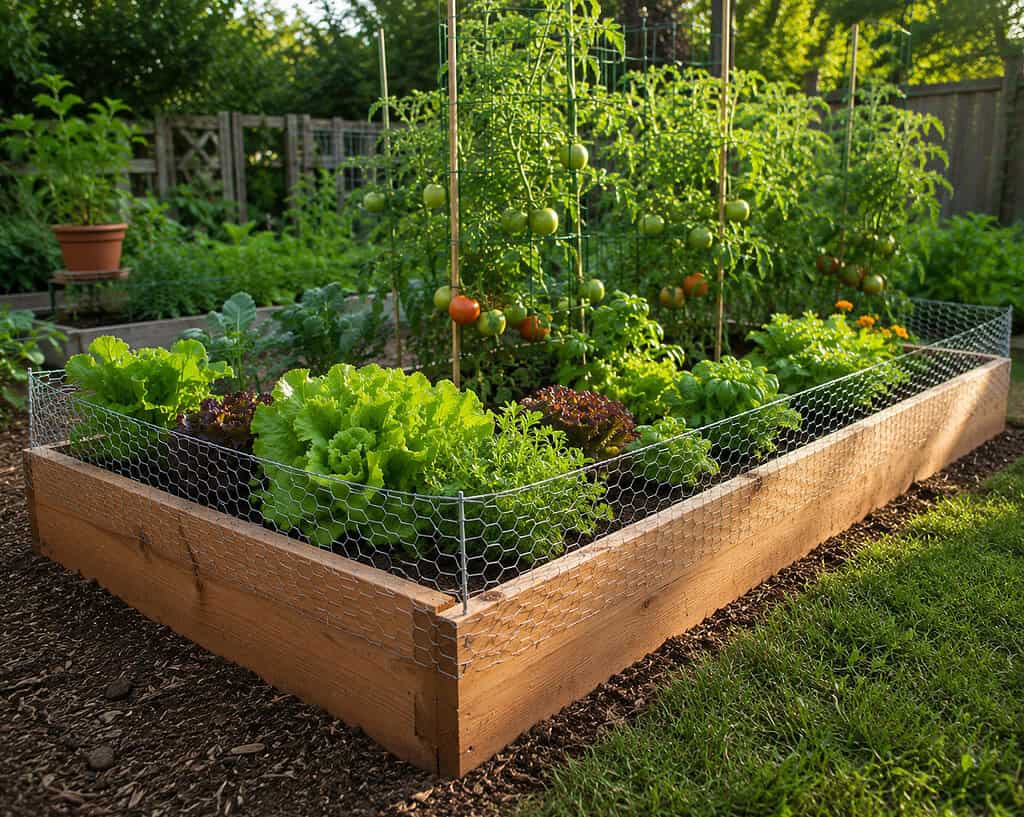
Wrap a 12–18 inch band of chicken wire around the outside of a raised bed and staple it to the top edge of the frame so it stands slightly proud of the wood.
Rabbits can’t get a clean jump over the lip, and the collar disappears visually once plants spill over the sides. It’s a subtle option for anyone who wants protection without the fenced-in look.
6. Wire-Backed Gate Panels

Gates are the weak point of almost every garden fence — there’s always a gap at the hinge or a sagging bottom corner.
Build a simple wooden gate frame and staple chicken wire across the back, overlapping the fence line by a few inches on each side so there’s no daylight for a rabbit to squeeze through.
Pair it with a spring closer so it never gets left ajar.
7. A Dual-Purpose Trellis Fence

Run chicken wire between two sturdy posts and you have both a barrier and a climbing structure.
Peas, beans, cucumbers, and small squash will happily scramble up it, turning a protective fence into growing space.
If you like the idea of vertical growing doing double duty, it pairs well with these clever zucchini trellis ideas for keeping sprawling vines off the ground.
8. Sunken Gopher Baskets
If your damage comes from below — gophers or voles pulling entire plants down into the soil — a vertical fence does nothing.
Line the bottom and sides of a planting hole (or the base of a raised bed) with chicken wire to form a basket, then backfill and plant inside it.
Roots grow through the mesh freely, but the crown of the plant stays anchored above a barrier the rodents can’t breach.
9. An Overhead Netting Roof

Birds and deer both approach from above your fence line — birds by landing, deer by reaching over.
Stretching chicken wire across the top of a fenced bed on a simple post-and-string frame closes that gap.
It doesn’t need to be tight or tidy; even a loose canopy is enough to make birds think twice and to physically block a deer’s neck from reaching in.
10. A Compost Enclosure That Doubles as a Barrier
Form a cylinder of chicken wire, secure the seam, and you have an instant compost bin that also keeps the pile contained and slightly critter-resistant.
Place it along your garden’s edge and it does two jobs at once.
Airflow through the mesh actually helps the pile break down — a nice bonus if you’re building soil with nutrient-rich cover crops and want somewhere to stash the trimmings.
11. A Skirt on Your Existing Fence

Already have a fence with gaps too wide at the bottom? Don’t replace it — skirt it.
Attach a 24-inch band of chicken wire along the lower portion of the existing fence and flare the base outward into an L-footer.
This is the cheapest possible upgrade for a fence that keeps big animals out but lets rabbits stroll right through.
12. Container and Pot Guards
Patio and balcony growers get hit too — squirrels dig in pots, birds pull at soft leaves. A small cone or dome of chicken wire pressed into the top of a container guards it without ruining the look.
This is an easy win if you’re working a narrow side yard or any tight space where a full fence would feel like overkill.
13. Portable Folding Panels
Build a few lightweight wooden frames wrapped in chicken wire and join them with loose hinges so they fold flat for storage.
Set them up as a temporary barrier wherever the pressure is worst this week, then move them as the season shifts.
They’re also handy for cordoning off a section when you let birds roam near a cozy small chicken coop and want to keep them out of the tender beds.
Garden Planner
The 22-page planner timed to your county's real frost dates. Planting windows, monthly checklists, and a harvest log you'll fill with pride by August.
Your Free 22-Page Garden Planner
Built for your exact ZIP code — planting dates, harvest log, and a month-by-month plan. 15-second sign-up.
How to Pick the Right Chicken Wire (It’s Not All the Same)
Grabbing whatever roll is cheapest is how people end up rebuilding a fence in two seasons. Three specs matter more than price:
- Mesh size. 1-inch mesh stops rabbits and most birds. 2-inch mesh is fine for containing chickens or blocking deer but will let baby rabbits and small birds straight through. Match the hole to the smallest animal you’re fighting.
- Gauge (wire thickness). Lower number means thicker wire. 19-gauge is standard and fine for most garden work; drop to 20-gauge only for light, temporary jobs. Anywhere an animal pushes or leans, go thicker.
- Coating. Galvanized-after-weaving wire resists rust far better than galvanized-before-weaving, because the cut ends get coated too. For anything staying out year-round, or in a wet climate, PVC-coated wire lasts the longest.
Installation Details That Decide Whether It Works
The same roll of wire can succeed or fail entirely based on how you put it up. A few things separate a fence that holds from one that sags open by August:
- Tension the top, anchor the bottom. Run a taut wire or a wooden rail along the top edge and secure the wire to it. Most sagging starts at the top and pulls the whole fence loose.
- Never skip the bottom gap. Whatever animal you’re stopping, the failure point is almost always the last inch at ground level. Bury it, pin it, or L-foot it — but close it.
- Overlap seams generously. Where two sections meet, overlap by several inches and lace them together with wire, not just a single tie. A one-tie seam is a door waiting to open.
- Post spacing matters. Set posts every 4–6 feet. Farther apart and the wire bellies out in the middle, giving animals a spot to push under or climb.
Keep your cutters, staples, and leftover rolls somewhere dry between projects — an organized garden storage shed saves you from buying a new pair of tin snips every spring because the old ones rusted in a bucket.
Miss it by a week and you lose the crop. The free 22-page planner pins down your exact dates — last frost, first frost, and the weekly steps between — so you plant on the days that actually work for your ZIP.
Free Planting Guides for This Article
Get exact planting dates, frost schedules, and growing tips for your zone:
The Honest Limits of Chicken Wire

Chicken wire is an exclusion tool for herbivores, not a predator barrier. Its thin, soft wire is designed to keep birds and rabbits out and to contain poultry — not to stop something determined to get in.
A raccoon can peel it back, and a persistent dog can chew through it.
If you’re protecting against predators — say, guarding poultry rather than lettuce — reach for hardware cloth instead. Its welded (not twisted) joints and heavier wire are what actually hold up to teeth and claws.
The same logic applies when you’re protecting young trees in a thriving backyard orchard, where a trunk guard needs to survive years of pressure, not one season. Use chicken wire for what it’s great at, and don’t ask it to do a job it was never built for.
And if your goal is as much about screening as protection, remember a fence and a living barrier work well together — a low wire fence at the base and a row of lush privacy shrubs behind it gives you a boundary that’s both functional and good-looking.
Start With the One Weak Spot That’s Costing You the Most
You don’t need to fence your entire property this weekend.
Walk your garden, find the single spot where you’re losing the most – the bed the rabbits keep finding, the row the birds strip bare – and fix that one first with whichever idea above fits it.
Solving your biggest leak first is faster, cheaper, and far more satisfying than building a perfect fence around a problem you didn’t actually have.
Which pest is winning the war in your garden right now – and which of these ideas are you going to try first?
Drop a comment below and tell us what you’re up against. If you’ve come up with a chicken wire hack of your own, share it so the rest of us can steal it.
Best gardening planner I've used in 10 years — and I keep coming back to it every season.
How Hard Is It to Garden in Your County?
Every county has a unique Gardening Difficulty Score based on frost risk, soil quality, drought, altitude, and climate trends. Find yours — plus personalized frost dates, planting calendars, and soil data.
Check Your County's Score →Plan Your Garden With Confidence!

Ever start planting… and then realize halfway through that things feel a little scattered?
A simple plan changes everything.
When you sketch your layout first, you can see what fits, what flows, and what actually makes sense for your space. It saves time, money, and a whole lot of second-guessing later.
Our free Garden Planner helps you map out beds, organize plant spacing, rotate crops, and keep track of seasonal tasks – all in a clean, printable format you can actually use.
Whether you’re designing a low maintenance front yard or planning your full homestead garden, this gives you a clear starting point.
Less chaos. More clarity. A garden that works.
Frequently Asked Questions
Is galvanized chicken wire safe to use around vegetables I’ll eat?
Yes. Galvanized wire is zinc-coated, and the tiny amount of zinc that might weather off over years is not a meaningful concern for garden soil or edible crops.
If you’d rather avoid metal contact entirely, keep the wire an inch or two off the plants themselves — which you’re usually doing anyway for airflow. PVC-coated wire is another fully food-safe option if you prefer.
What’s the easiest way to cut and join chicken wire without shredding my hands?
Wear leather gloves, cut with a proper pair of tin snips or wire cutters, and cut through the twisted joints rather than mid-strand so you leave fewer sharp spurs.
To join two pieces, overlap them and “sew” them together with short lengths of the same wire or with hog rings and pliers.
Fold any cut ends back on themselves so the pokey bits face inward, not toward you or the animals.
Can I paint chicken wire so it’s less visible in the garden?
You can, and it genuinely helps it disappear. A coat of matte black or dark green spray paint made for metal makes the mesh recede into the background — the eye reads the plants instead of the grid.
Let it cure fully before it touches foliage, and stick to flat finishes; glossy paint catches light and makes the wire more obvious, not less.
How do I keep chicken wire tight so it doesn’t sag over time?
Sagging almost always comes from the top edge, so run a tensioned support wire or a wooden top rail and fasten the mesh to it before you worry about the sides.
Pull the wire taut as you staple, work from one end to the other rather than tacking the middle first, and re-tension once after the first few weeks when everything has settled. Closely spaced posts do most of the heavy lifting here.
Should I take chicken wire down for winter?
For permanent fencing, no — quality galvanized or PVC-coated wire handles winter fine, and pests still browse dormant beds and bark.
What’s worth doing is taking down lightweight, temporary pieces like cloches and folding panels so heavy snow load doesn’t crush them out of shape. Store those flat and dry, and they’ll be ready to redeploy in spring instead of bent into scrap.
Level Up Your Garden
Our most popular gardening guides